
Authentic Raw Honey: How to Spot Lab-Tested Quality
Quick Summary
Lab tested honey is a sample sent to a food laboratory and checked against defined markers of purity, origin and processing. Authenticity depends on which analyses were run, such as C4 sugar, NMR and pollen tests, and whether the result matches the batch on the jar.
- Check which analysis was run, since a jar can be labelled lab tested after a single test.
- C4 sugar results should sit below the reference threshold, commonly around 7 per cent.
- Confirm the batch number on the certificate matches the batch code on your jar.
- Prefer an accredited laboratory, such as one operating to ISO/IEC 17025, over an unnamed facility.
- Home tests like the water or thumb test cannot detect syrup blending and should not decide authenticity.
Table of Contents
- What Lab Tested Honey Actually Means
- Raw Honey vs Processed Honey: What Changes in the Jar
- How Honey Adulteration Is Detected and the UK Rules Behind It
- Common Adulterants and How Fake Honey Is Made
- Decoding a Lab Report: C4 Sugar Tests, NMR and Origin Data
- How to Test Honey Purity at Home and Where Home Tests Fall Short
- Does Filtration Affect Enzymes and Quality?
- Geographic Origin Fraud and Why Single-Origin Sourcing Matters
- Choosing Authentic Raw Honey and Checking Our Lab-Tested Range
- Frequently Asked Questions
What Lab Tested Honey Actually Means
Last Updated: November 14, 2026
Lab tested honey means a sample has been sent to a food laboratory and checked against defined markers of purity, origin and processing. Wildabouthoney sources its raw honeys directly from independent master artisan beekeepers in Greece and Portugal, and its range is lab tested for purity. Understanding what those tests cover is the fastest way to tell an authentic raw honey from a product that only looks the part.
The word "tested" alone tells you very little. A jar can be sent for one analysis and still be labelled lab tested, so the useful question is which analysis was run and what it measured. Common checks include sugar profile analysis, moisture content, enzyme activity and pollen content, and some laboratories add NMR (nuclear magnetic resonance) testing to reveal syrup blending that other tests miss. A single result rarely settles the question.
Lab tested honey also has limits you should know about. A test confirms what was in the sample at the moment it was taken, not what happened to the rest of the batch. That is why traceability to a specific beekeeper and floral source matters as much as the certificate itself.
Raw Honey vs Processed Honey: What Changes in the Jar
Raw honey is honey that has not been heated, ultra-filtered or otherwise processed beyond straining out wax and debris.
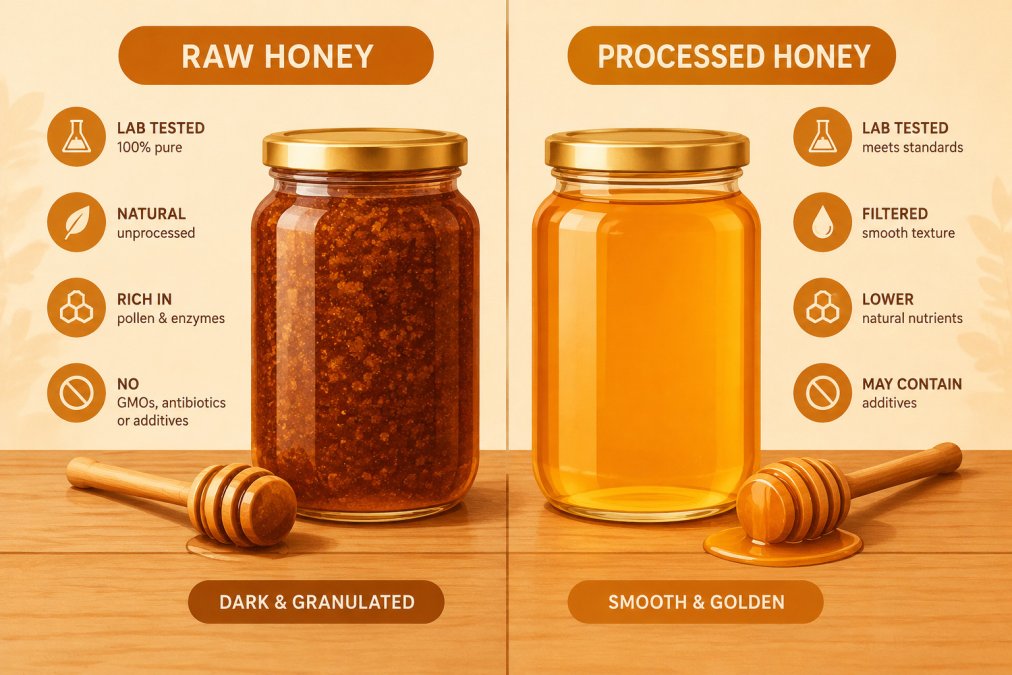
!Two glass jars of honey side by side on a wooden kitchen table, one dark and granulated, one smooth and golden, with a wooden dipper beside them
The differences you can see and taste are real. Raw honey often granulates over time, which is a natural sign of a honey with its sugars and pollen intact rather than a fault. Processed honey stays liquid for longer because heating and fine filtration remove the nuclei that trigger crystallisation. Flavour is usually more pronounced and varied in raw honey, reflecting the floral source, and pollen grains are often visible under light.
Heat and ultra-filtration also affect enzymes, which are the most sensitive part of the honey's composition. This is discussed later in this guide.
How Honey Adulteration Is Detected and the UK Rules Behind It
Honey adulteration usually means sugar syrup has been added, or that honey from one source has been blended with cheaper honey and sold as something else. Detection relies on laboratory methods that compare the sugar and isotope profile of a sample against known honey reference values. In the UK, honey is covered by the Honey (England) Regulations and related food labelling rules, and it must meet defined composition standards before it can be sold as honey. Check the current wording on the Food Standards Agency guidance on honey labelling before relying on any specific rule.
Because the rules set out what honey must be, a lab result is meaningful only when it is compared against those standards rather than read in isolation.
Common Adulterants and How Fake Honey Is Made
The most common adulterant is inexpensive sugar syrup, often produced from corn, rice or beet sugar. Syrup can be fed to bees, which then produce honey with a sugar profile that looks closer to natural honey, a practice that makes simple sugar tests less reliable on their own. Blending is the other route: a small amount of genuine honey is mixed with large volumes of cheaper product and labelled as a premium variety.
Fake honey is often sold on price. If a jar of a rare single-origin honey costs less than the usual market rate, the discount is worth questioning rather than celebrating.
Decoding a Lab Report: C4 Sugar Tests, NMR and Origin Data
A lab report is only useful if you can read what each section is telling you, and if you can tell a batch-level certificate from a decorative PDF. Three analytical components matter most, and each has a specific thing to check.
C4 sugar analysis. This measures the ratio of carbon isotopes in the honey's sugars. Plants that use the C4 photosynthetic pathway, maize, sugar cane, sorghum, leave a different carbon isotope signature from the C3 plants that nectar-bearing flowers use. Added C4 syrup therefore shifts the ratio. The result is usually expressed as a percentage, and the reference threshold used in the trade is commonly around 7 per cent, though the exact figure depends on the method and the laboratory. A result comfortably below the threshold is a positive signal; a result at or above it warrants an explanation from the supplier.
NMR testing. Nuclear magnetic resonance produces a fingerprint of the sugars and other compounds in the sample. It can detect blends, rice and beet syrups that a single isotope test may miss, and it is increasingly used for batch verification because it compares the sample against a reference database of authentic honeys. Ask whether the NMR result is a full profile or a single marker, because the two carry very different weight.
Origin and pollen data. This records where the honey came from, country, region and often floral source, and may include pollen analysis, which supports the botanical claim. Origin claims are only as strong as the traceability behind them, so a named beekeeper and a documented harvest date matter as much as the data itself.
What a Credible Certificate of Analysis Should Contain
A genuine batch-level CoA is more than a single number. Look for the following before you rely on it.
- Batch or lot number that matches the jar you are holding. A report with no batch reference cannot be tied to your honey.
- Harvest or production date consistent with the label. A report dated years before the jar was filled tells you little about the contents.
- Laboratory name and accreditation. An accredited food laboratory, for example one operating to ISO/IEC 17025, gives more weight to the result than an unnamed or in-house facility.
- Sample type and chain of custody. A sample drawn from the production batch is more relevant than a single unlabelled sample submitted by the supplier.
- Full results, not a summary. A credible report shows the measured values, the method used and the reference threshold, not just a pass or fail stamp.
- Consistency across tests. C4, NMR and pollen results should agree. A report that presents one favourable test and omits the others is a warning sign.
Watch out: a supplier may show a report for a different harvest or a different product in the range, so always check that the batch number on the certificate matches the batch code on the jar.
Reading the C4 Sugar Result Step by Step
- Find the C4 percentage on the report and note the reference threshold stated alongside it.
- Check the report date and batch number against the jar you hold, so the test relates to your honey and not a different harvest.
- Look for the laboratory's name and accreditation mark, and confirm the method is stated.
- Confirm the sample type and whether chain of custody is documented.
- Compare the NMR and origin sections with the C4 result. Agreement across all three is a stronger signal than any single test.
A lab report is evidence, not a guarantee. It confirms what was in the sample at the moment it was taken, which is why the strongest suppliers pair a transparent CoA with traceability to a named beekeeper and a stated floral source. Ask for the report for the batch you are considering, read it against the checklist above, and treat any reluctance to share it as information in itself.
The table below summarises the three analyses a lab report covers and what each one tells you to check.
| Test | What it measures | What to check |
|---|---|---|
| C4 sugar analysis | Carbon isotope ratio of sugars | Result below the reference threshold |
| NMR testing | Full sugar and compound fingerprint | Full profile, not a single marker |
| Origin and pollen data | Country, region and floral source | Named beekeeper and harvest date |
How to Test Honey Purity at Home and Where Home Tests Fall Short
Home purity tests circulate widely because they are cheap, fast and satisfying to perform. The problem is that almost none of them measure what they claim to measure. Below is what each popular method actually detects, why it produces false results, and what it can and cannot tell you about authenticity.
The water test. A spoon of honey dropped into a glass of water is said to dissolve slowly if genuine and quickly if adulterated. In practice, dissolution rate is governed by moisture content, temperature and the surface area of the honey blob. A high-moisture genuine honey can sink and disperse quickly, while a thick sugar syrup can sit at the bottom looking convincingly "pure." The test measures viscosity, not origin.
The thumb test. A dab of honey on the thumb is said to hold its shape if pure. This is a crystallisation and viscosity check. Set honey, which is a natural state for many raw honeys, will behave differently from runny honey of identical purity, so the test penalises exactly the raw, unprocessed product it is supposed to identify.
The flame test. A match dipped in honey is said to light easily only if the honey is pure. Water content is the variable here: honey with higher moisture resists ignition, while a syrup with low moisture may burn cleanly. The test tells you about water, not about added C4 sugars or syrup blending.
The vinegar test. Adding honey to vinegar and looking for curdling is claimed to reveal adulteration. Curdling reflects protein or mineral interactions and is not a validated marker of sugar syrup addition. Genuine honey can cloud, and adulterated honey can stay clear.
The paper or tissue test. A drop on blotting paper is said to leave a water ring if adulterated. Again, moisture content drives the result. Honey naturally varies in moisture by floral source and harvest conditions, so a ring is not evidence of syrup.
The ant test. Ants are said to avoid pure honey. This is folklore. Ants are attracted to sugars generally and will feed on genuine honey given the chance.
Watch out: a genuine raw honey can fail several of these tests and an adulterated syrup can pass all of them, so never use a home result to accept or reject a jar on its own.
Why the tests fail is structural. Authenticity depends on isotope ratios, sugar profiles and pollen signatures that are invisible to the senses. A water test cannot detect cane sugar added at 10 per cent, a thumb test cannot reveal rice syrup, and a flame test cannot distinguish Greek fir honey from a blend. Only laboratory methods, C4 sugar analysis, NMR profiling and pollen analysis, operate at the level where adulteration actually shows up.
That does not make home tests worthless as a first filter. A honey that smells of nothing, tastes uniformly sweet with no floral or resinous note, and shows no sign of granulation over many months is worth questioning. But treat sensory impressions as a prompt to ask for a lab report, not as a substitute for one. If a supplier cannot produce a batch-level certificate, the home test result is irrelevant either way.
Does Filtration Affect Enzymes and Quality?
Yes. Enzymes such as diastase and invertase are heat-sensitive, and both heating and fine filtration can reduce their activity. Raw honey that has been strained but not heated or ultra-filtered keeps more of these enzymes, along with the pollen and natural compounds that filtration removes. Once you have a jar, our guide on how to store raw honey properly at home explains how to keep those qualities intact.
Enzyme loss does not mean a filtered honey is unsafe or fake. It means the product has been changed in a measurable way, and that difference matters if you are buying for the composition rather than the sweetness alone.
Geographic Origin Fraud and Why Single-Origin Sourcing Matters
Geographic origin fraud occurs when honey is labelled as coming from one country or region but was produced elsewhere, or blended from several origins. Single-origin sourcing counters this by tying the jar to a named region, beekeeper and harvest. Wildabouthoney's Serra da Estrela mountain honey, for example, is sourced from the Guarda region of northern Portugal.
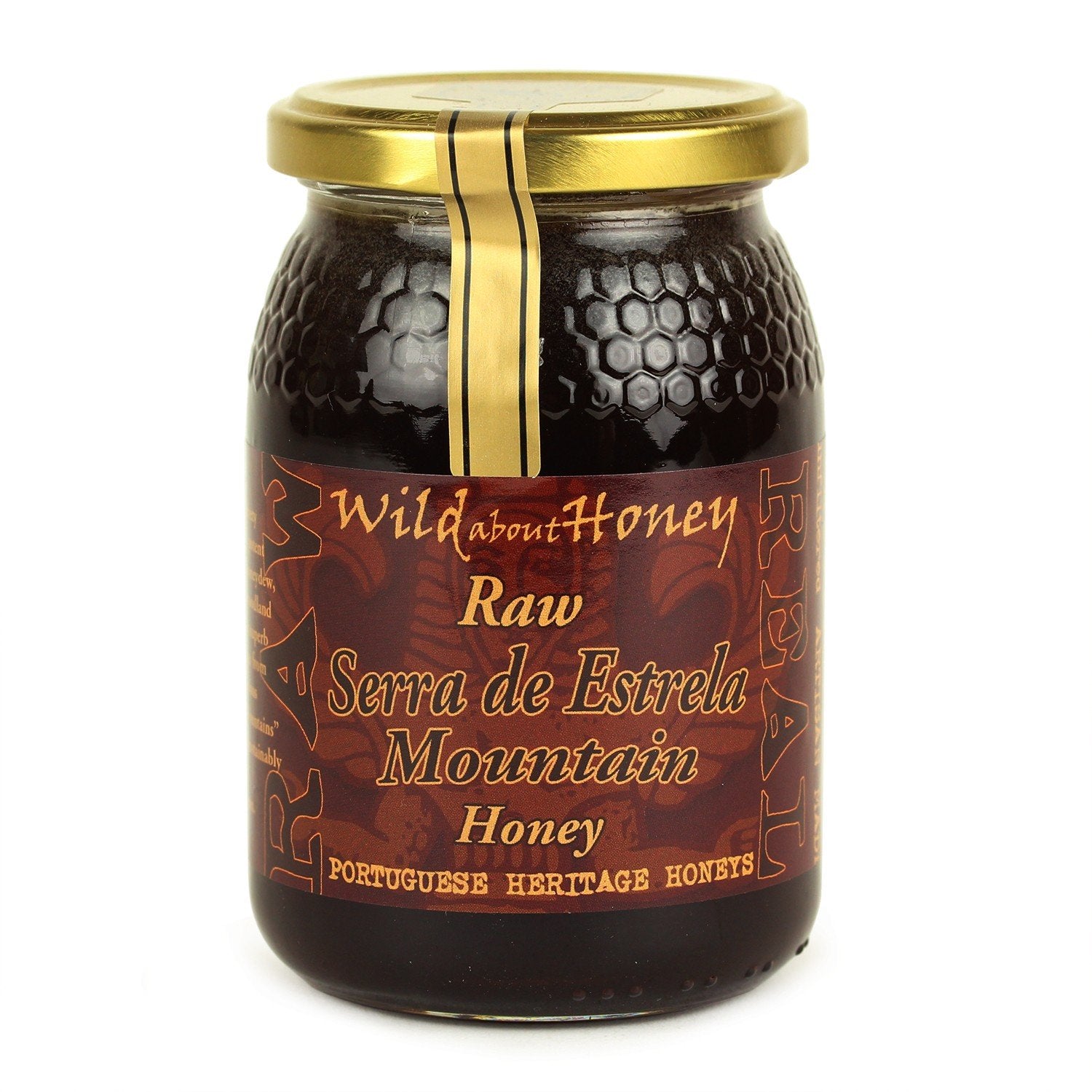
Origin is more than a marketing detail. A documented origin lets you check the honey's profile against what that region and floral source should produce, which is one of the few ways a buyer can test a label claim against expectation.
!A pale wooden table set with a small glass jar of dark honey, a honey dipper and a sprig of oak leaves in soft natural light
Choosing Authentic Raw Honey and Checking Our Lab-Tested Range
Start with a clear checklist: a named beekeeper, a stated floral source, a batch-level lab result and an unprocessed description. Then compare the products on those criteria rather than on price or label wording alone.
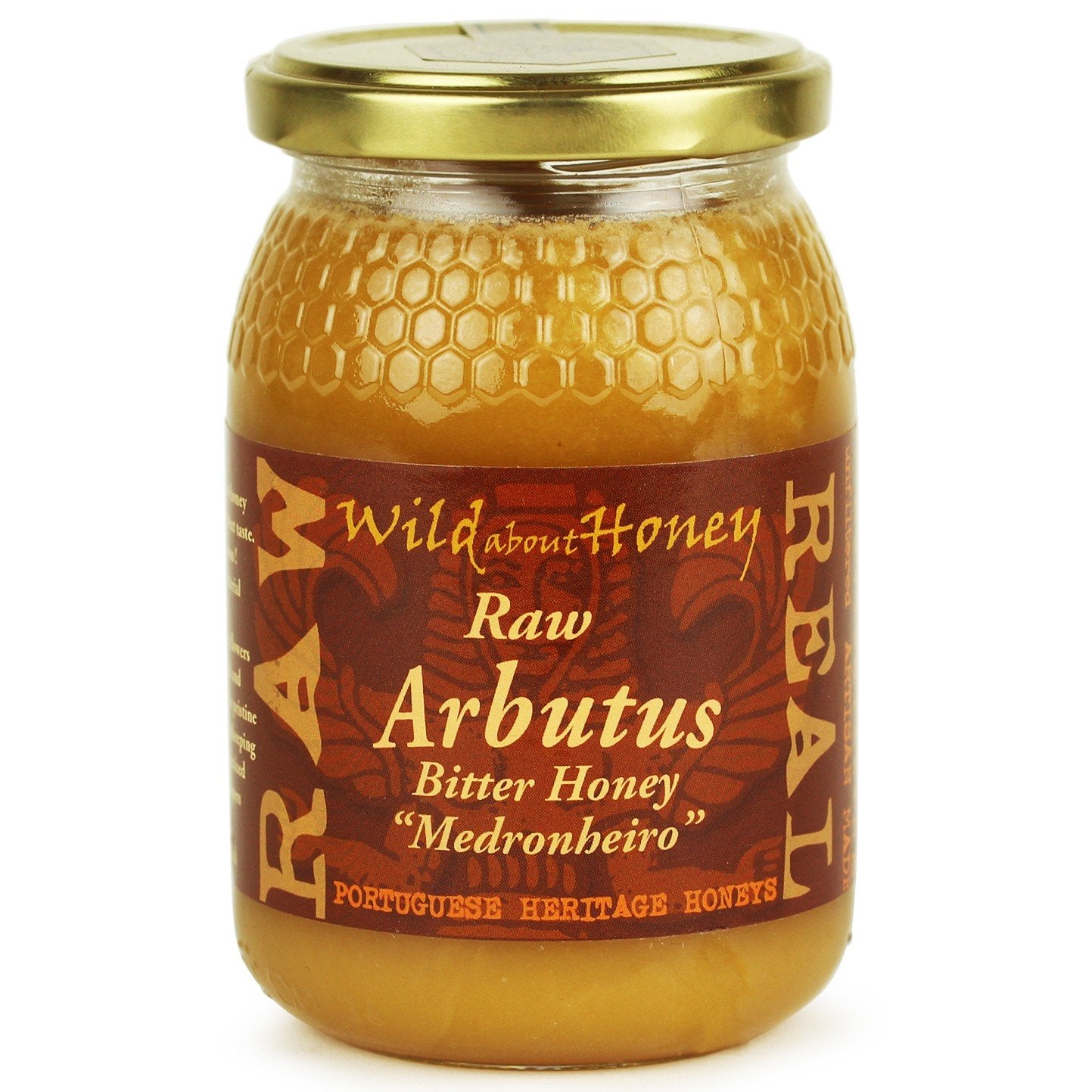
Our current range includes raw Portuguese Arbutus honey from the Serra da Monchique at £14.99, a raw Arbutus and Wildflower honey at £12.99, and a raw Greek Vanilla Fir honey at £7.99. For a dark, richly flavoured option, the raw Serra da Estrela mountain honey is priced at £26.99, and the raw Greek Red Fir honey at £20.99.
Before you buy, ask us for the lab report for the batch you are considering. Any reputable supplier should be able to show you one. For an overview of the artisan honey market and where to find trustworthy sources, see our guide to Raw Honey Shop Alternatives: Where to Buy Artisan Honey. If you want to see how a documented lab result compares with a supermarket jar, our piece on why supermarket honey is fake walks through what the tests show.
Frequently Asked Questions
What does lab-tested honey actually mean?
Lab tested honey has been sent to a food laboratory, which measures specific markers of purity and origin. The results show whether the honey contains added cane or beet sugar syrups, and whether its composition fits the floral or geographic origin on the label. A lab test does not guarantee that honey is raw, so it should be read alongside the processing information.
How can you tell if raw honey is authentic?
No single check proves authenticity. Authentic raw honey usually has a clear origin story, a named beekeeper or producer, a batch number that links to a lab report, and labelling that states it has not been heated or ultra-filtered. Natural crystallisation is a good sign rather than a fault, since honey that never granulates is often heated or blended. Combining these signs with a lab certificate gives far more confidence than any one of them alone.
Is supermarket honey usually raw and authentic?
Many supermarket honeys are blends sourced from several countries and are often heat-treated and ultra-filtered to keep them clear and stop them crystallising. Some are perfectly genuine, but the label rarely identifies the beekeeper or the single origin, which makes verification difficult. If you want honey with a traceable hive-to-jar history, look for named origin, batch testing and a clear statement of processing, and check what the lab actually tested for.
What are the common adulterants found in fake honey?
The most common adulterants are sugar syrups made from cane, beet or corn, including high-fructose corn syrup and rice syrup. These are cheaper to produce and can mimic the sweetness and viscosity of honey. Some producers also feed bees sugar syrup, which then appears in the honey and is picked up by C4 sugar testing and NMR analysis. Adulteration can be hard to spot by taste alone, which is why laboratory testing matters for premium products.
What is the difference between raw and processed honey?
Raw honey is generally described as not heat-treated or finely filtered, which means more of its natural character is kept. Processed honey is typically heated to dissolve crystals and pasteurise it, then ultra-filtered to remove pollen and produce a clear, slow-to-crystallise product. Processing makes honey easier to handle and sell in bulk, but it can reduce enzyme activity and pollen content. Raw honey may crystallise naturally, and that is normal.


Comments on this post (0)