
The Best Raw Honey for Daily Health and Everyday Wellbeing
Last Updated: November 24, 2026
Quick Summary
The best raw honey for daily health is a single-origin, unheated and unfiltered jar from a named beekeeper, used at roughly one to two teaspoons (10 to 15 grams) a day. Raw honey keeps the pollen, enzymes and aromatic compounds that pasteurisation and heavy filtering remove, so it offers mild antioxidant and antibacterial upside rather than a cure.
- Keep free sugars below 30 grams a day, the NHS guidance for adults.
- Never give honey to infants under 12 months because of infant botulism risk.
- Warm a crystallised jar in hand-hot water around 40°C and stir gently.
- Avoid microwaving or heating raw honey above about 40°C to protect enzymes.
- Store jars tightly closed at room temperature and skip refrigeration.
Table of Contents
- Why Raw Honey Earns a Place in Your Daily Routine
- Raw Honey Benefits: What the Evidence Actually Supports
- Raw Honey vs Regular Honey: What Processing Takes Away
- How Much Honey Per Day Fits a Healthy Diet
- How to Choose Raw Honey You Can Trust
- Five Raw Honeys Worth Keeping on the Shelf
- Frequently Asked Questions
Why Raw Honey Earns a Place in Your Daily Routine
Most jars sold as honey have been heated and fine-filtered until little remains beyond sweetness.
A spoonful stirred into tea or spread on toast is one of the oldest daily habits there is. The question worth asking in 2026 is not whether honey is nice.
Below, we break down what the evidence supports, how much fits a normal diet, and which five jars we would actually keep on the shelf.
Raw Honey Benefits: What the Evidence Actually Supports
Raw honey benefits are real but narrower than most labels suggest. The strongest case is for antioxidants and antibacterial activity, both of which are well documented in laboratory work. The weakest case is for anything resembling a cure.
Antioxidants, Enzymes and Antibacterial Properties
Honey contains phenolic compounds and enzymes that heat treatment can reduce.
Antibacterial properties are the most studied area. Manuka honey is famous for methylglyoxal, but it is not the only active honey. Research published in the Journal of Applied Microbiology has documented hydrogen peroxide activity across many raw honeys, and some varieties carry additional non-peroxide activity.
What this means in practice: a raw, unheated honey is a reasonable everyday food with mild functional upside. It is not a substitute for medical treatment.
Where the Health Claims Get Ahead of the Evidence
Here is the part most guides skip. Many claims attached to raw honey come from laboratory studies using concentrated extracts, not from a teaspoon in your tea. That is a meaningful gap.
Digestive benefits, for instance, are widely repeated but thinly evidenced in human trials. We treat them as plausible rather than proven. If a jar promises to fix your gut, treat that as marketing.
Raw Honey vs Regular Honey: What Processing Takes Away
The core difference between raw honey and regular honey is heat and filtration. Commercial honey is typically warmed to make it easier to filter and bottle, which keeps it runny and clear on the shelf. That convenience has a cost.
| Feature | Raw Honey | Regular Honey |
|---|---|---|
| Heat treatment | None or minimal | Often pasteurised |
| Pollen content | Retained | Largely filtered out |
| Texture over time | Crystallises naturally | Stays runny |
| Flavour complexity | High, varies by batch | Uniform |
| Traceability | Usually single-origin | Often blended |
Crystallisation is the tell. A raw honey that never sets is unusual, and many people mistake crystallisation for spoilage. It is not. Warming the jar gently in hand-hot water restores it.
How Much Honey Per Day Fits a Healthy Diet
A sensible daily amount is roughly one to two teaspoons, about 10 to 15 grams. That fits comfortably inside the free-sugar guidance from the NHS, which advises adults to keep free sugars below 30 grams a day.
Honey is still sugar. It carries the same calorie load as table sugar and the same effect on teeth.
Watch out: honey should not be given to infants under 12 months, because of the risk of infant botulism. That guidance is standard and applies to all honey, raw or not.
How to Choose Raw Honey You Can Trust
Choosing well comes down to three checks: origin, processing and testing. A jar that names a beekeeper and a region is easier to trust than one that names a country and nothing else. This section gives you a usable verification checklist rather than vague purity language, and it explains what to do when the honey crystallises, the practical question most benefit-led pages ignore.
Reading the Label and Verifying Authenticity
Look for the words raw and unfiltered together, plus a specific floral source. Vague terms like "pure honey" tell you nothing, since nearly every jar claims it. The checklist below is designed to be used in a shop or on a product page.
- Does the label name a region or beekeeper, not just a country?
- Is a floral source stated, such as thyme, heather or arbutus?
- Is raw or unpasteurised stated explicitly, not implied?
- Is there any mention of lab testing for purity or adulteration?
- Does the seller state a harvest season or batch number?
- Does the honey crystallise over time, as raw honey normally does?
- Is the price plausible for single-origin raw honey, or suspiciously cheap?
If a seller cannot answer where a jar came from, that is your answer. A common pattern among trustworthy sellers is that they name the beekeeper, the region and the harvest window, and they are willing to explain how the honey was extracted and whether it was heated.
Storage, Crystallisation and Cooking
Crystallisation is the tell. A raw honey that never sets is unusual, and many people mistake crystallisation for spoilage. It is not.
To restore a crystallised jar, warm it gently in hand-hot water, around 40°C is enough, and stir.
Store jars tightly closed at room temperature, away from direct sunlight. Refrigeration is not necessary and can speed crystallisation.
For cooking, raw honey works in dressings, marinades and baking, but the heat will reduce its raw qualities.
Five Raw Honeys Worth Keeping on the Shelf
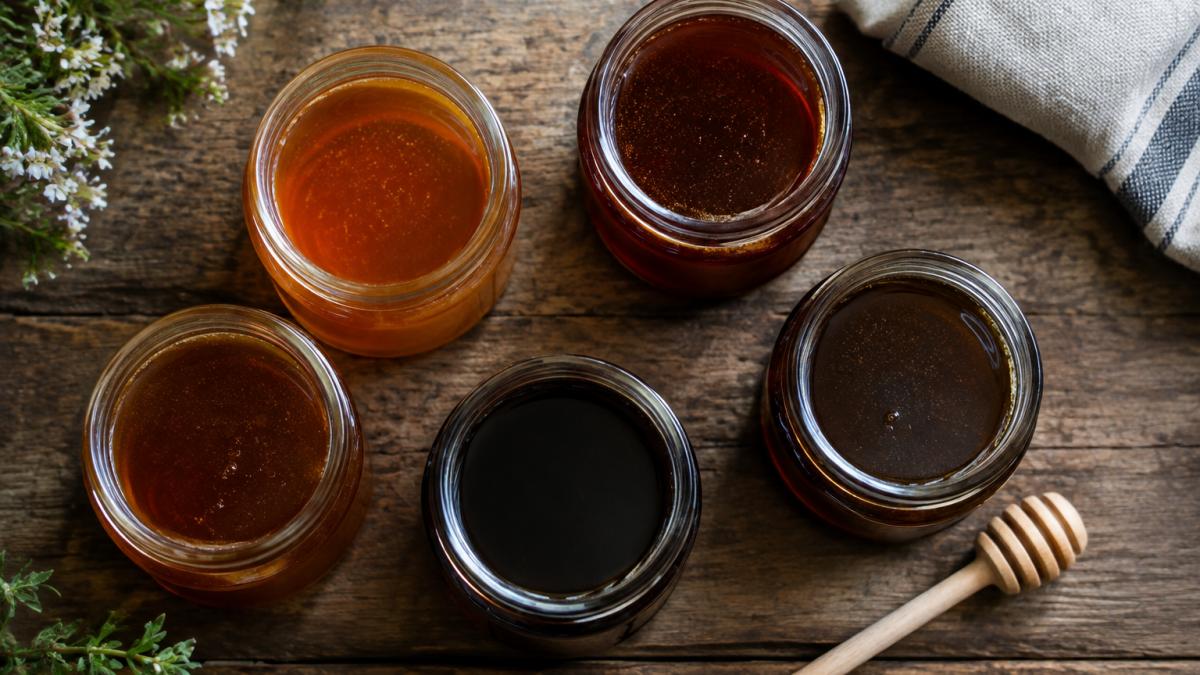
These are the jars we would reach for daily, chosen for traceability, flavour and how well each holds up in ordinary use.
Raw Greek Red Fir Honey
This is a honeydew from the mountains of central Greece, dark and smooth with a mild sweetness and a slightly herbaceous edge.
Because honeydews are rich in longer-chain sugars, they crystallise slowly, which makes this an easy jar to keep on the counter. We would use it in tea, over yoghurt, or straight off the spoon.
Best for: a single daily jar that suits almost everything. Skip if: you want a strong, assertive flavour.
Raw Portuguese Arbutus Bitter Honey
The most unusual jar here. Arbutus, or strawberry tree honey, comes from the Serra da Monchique and tastes like bitter caramel. It is not for everyone, and that is the point.
A Great Taste Award winner in 2020, it costs £14.99. If the bitterness appeals, try the Raw Portuguese Arbutus Bitter Honey.
Best for: the curious palate and anyone who finds standard honey too sweet. Skip if: you want a mild, crowd-pleasing flavour.
Raw Algarvian Wildflower Honey
A three-star Great Taste winner in 2020, and the most versatile jar in the range. This dark wildflower honey is cold-extracted and unfiltered, made from spring flowers across the western Algarve, including carob, wild lavender and borage.
At £26.99, shop the Raw Algarvian Wildflower Honey.
Best for: gifting and everyday use where flavour should please everyone. Skip if: you specifically want a single-flower honey.
Raw Algarvian Heather Honey
Portuguese heather, known locally as urze, produces a dark, viscous, smoky honey with a strong aroma. It comes from the Erica family rather than Scottish ling heather, so it stays rich and pourable rather than jelly-set.
It costs £13.99. If you like a bold honey, order the Raw Algarvian Heather Honey.
Best for: strong flavours, winter drinks and anyone who likes a smoky note. Skip if: you prefer light, delicate honey.
Raw Greek Kalymnos Thyme Honey
Thyme honey from Kalymnos is golden and intensely aromatic.
A Kalymnos thyme honey has taken three stars at the Great Taste Awards, and this jar costs £22.99. Buy the Raw Greek Kalymnos Thyme Honey.
Best for: the medicine shelf and anyone who wants a classic thyme honey. Skip if: you dislike strong herbal aromas.
The gap between an ordinary jar and a genuinely raw one is wider than most people expect, and it shows up in the first spoonful.
We built wildabouthoney around single-origin jars from named beekeepers, free from additives.
Frequently Asked Questions
What is the best raw honey to eat every day?
There is no single best jar, but a smooth, mild honeydew such as Raw Greek Red Fir works well for daily use because it is subtle, slightly herbaceous and only mildly sweet, so it does not overpower tea or porridge. If you want a bolder flavour, a dark honey like Raw Algarvian Heather or Raw Arbutus delivers a stronger taste in a smaller spoonful. Match the jar to how you take it: mild for drinks, bold for toast or yoghurt.
Is raw honey healthier than regular honey?
Raw honey is not pasteurised or fine-filtered, so it keeps more of its natural enzymes, pollen and antioxidant compounds than the heat-treated, heavily filtered honey sold in most supermarkets. The practical difference is that raw honey is a less processed food with more traceable floral character, which matters if you are choosing honey for flavour and purity rather than sweetness alone.
How much honey is it safe to eat daily?
Treat honey as a sugar, not a supplement. If you are watching your blood sugar or managing diabetes, speak to your GP before making honey a daily habit, and never give honey to children under 12 months.
How can I tell if honey is raw and unblended?
Look for a named beekeeper or region, a single floral source where possible, and wording that says raw, cold-extracted and unfiltered rather than just natural. Crystallisation is a good sign, since raw honey sets over time and loosens again in a pan of hand-hot water. Ask the seller what checks they carry out on the honey. A producer who can name the person and place behind the jar is far more credible than one selling a story with no traceability.
Can raw honey be used in tea or cooking?
Yes, but keep the heat gentle. Stir raw honey into tea once it has cooled to drinking temperature rather than straight into boiling water. For cooking, add it late in the process or use it in dressings, glazes and no-bake recipes. A runny wildflower or chestnut honey works well in coffee and festive glazes, while a mild fir honey suits everyday drinks.
Prices of the five raw honeys


Comments on this post (0)