
Artisan Greek Honey Tasting Notes: A Connoisseur's Guide
Last Updated: November 4, 2026
Quick Summary
Artisan greek honey tasting notes are shaped by terroir, so thyme honey tastes bright, aromatic and faintly herbal while pine honey is dark, resinous and savoury with a bitter edge. Taste like a professional by looking, smelling, tasting and assessing the finish, keeping samples to four or five per sitting.
- Bring every jar to room temperature, around 20°C, at least an hour before tasting.
- Score aroma, sweetness, acidity, bitterness and finish from one to five on a simple sheet.
- Start with thyme if you are new to tasting, as its brightness is easier to read.
- Thyme honey is the best all-rounder for cheese pairing, cutting salty and creamy cheeses.
- Crystallization is natural and not a sign of poor quality in raw honey.
Table of Contents
- Why Artisan Greek Honey Tastes Different
- How to Taste Honey Like a Professional
- Thyme Honey vs Pine Honey Flavour Profile
- The Main Greek Honey Varieties and Their Tasting Notes
- Regional Micro-climates and Terroir in Greek Honey
- Best Greek Honey Varieties for Cheese Pairing
- Crystallization, Viscosity and Texture Explained
- Honey Fraud and How to Check Purity
- Frequently Asked Questions
Why Artisan Greek Honey Tastes Different
The difference between mass-market honey and artisan greek honey tasting notes begins in the jar, not on the tongue. Artisan Greek honey is raw, unblended, and shaped by the plants, soil and climate of a specific place. Sourcing jars directly from independent beekeepers keeps that variation intact rather than smoothing it out.
Greek honey is a study in terroir, the same concept wine lovers apply to vineyards. A thyme honey from a dry Aegean hillside tastes resinous and herbal; a pine honey from a forested region tastes darker and more savoury. Neither is "better." They are simply different expressions of where the bees worked.
Monofloral, Raw and Unprocessed: What the Labels Mean
Monofloral honey is honey where one nectar source dominates, giving a recognisable flavour, such as thyme or pine. Raw honey has not been heated or fine-filtered, so it keeps its natural enzymes and pollen. Unprocessed means nothing has been added or removed. These labels matter because they predict what you will taste. A monofloral thyme honey should taste of thyme, not of a generic sweet syrup.
How to Taste Honey Like a Professional
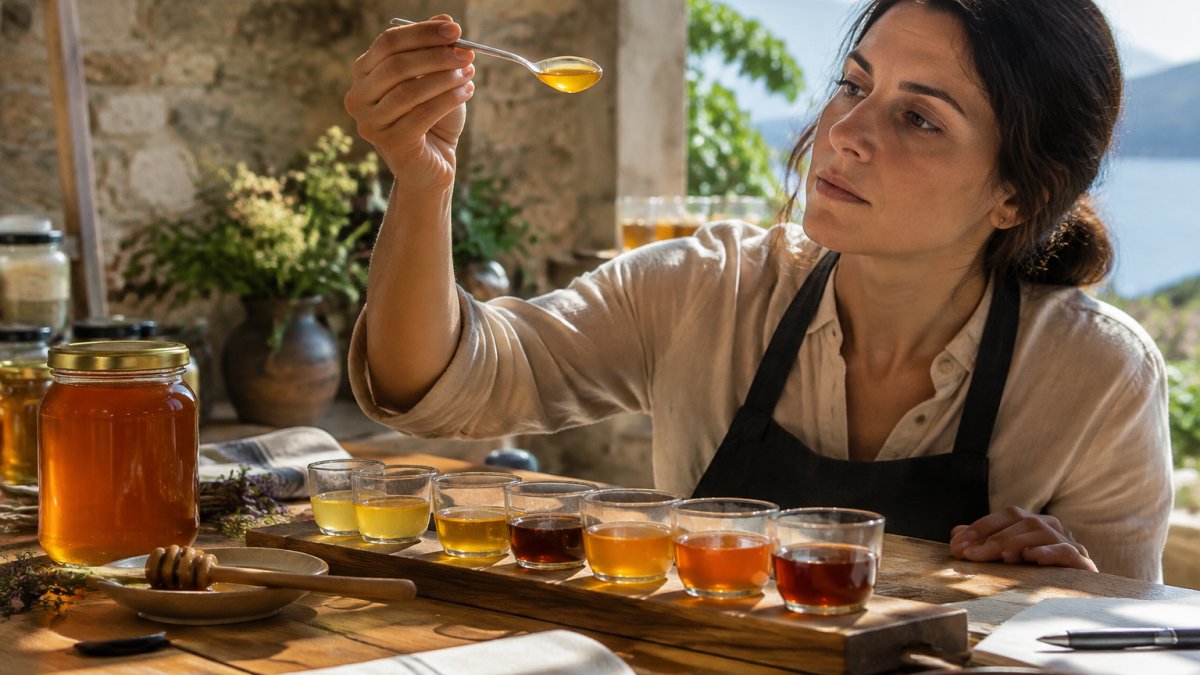
Tasting honey well means slowing down and using your senses in a fixed order: look, smell, taste, then assess the finish. Noting colour, aroma, sweetness, acidity, bitterness and aftertaste before forming a verdict gives a more reliable result than a casual spoonful.
Setting Up a Tasting Session
Use small glasses or tasting spoons, one per honey, and keep the samples to no more than four or five in a sitting, palate fatigue sets in quickly with something as sweet as honey. Bring every jar to room temperature (around 20°C) at least an hour before you start, because cold honey tightens the aroma and thickens the texture until every sample reads as 'sweet and slow'. Have plain water and a neutral carrier such as a piece of plain bread or a slice of apple on hand for palate cleansing between samples. Taste lighter honeys before darker ones, and monofloral before wildflower, so the resinous forest honeys do not coat the palate and flatten everything that follows.
The Four-Step Sensory Method
- Look. Tilt the jar and note the colour and viscosity. Hold the jar against a white background if you can. Slow, heavy movement often signals a dense, low-moisture honey; a fast, thin flow suggests higher moisture. Colour is not a quality signal on its own, pine and fir run dark, thyme runs amber, but it should be consistent with the stated variety.
- Smell. Warm the jar briefly in your hands, then inhale with your mouth slightly open. Look for floral, herbal or resinous notes before you taste anything. Aromas sit in three layers: the top note (floral, citrus), the middle (herbal, woody) and the base (caramel, resin). Note which layer dominates.
- Taste. Take a small spoonful and let it spread across your palate rather than swallowing straight away. Note sweetness first, then acidity, then bitterness. A useful trick is the 'viscosity test': tilt your head and let the honey slide slowly across the tongue, a thick honey moves as a single ribbon, a thinner one breaks apart. Thickness is not the same as quality, but it tells you about moisture content and nectar source.
- Assess the finish. Swallow slowly and time the aftertaste. A long, complex finish is the mark of a quality honey; a short, flat finish usually means heat treatment or a bland nectar source. Note whether the finish is clean, bitter, warming or metallic.
A common mistake is tasting cold honey straight from the fridge. Cold dulls aroma and thickens texture, so let the jar reach room temperature first. The mouthfeel you notice then, whether silky, grainy or syrupy, tells you as much as the flavour.
Scoring What You Taste
Professionals rarely rely on memory alone. A simple scoring sheet with five columns, aroma, sweetness, acidity, bitterness and finish, each rated from one to five, turns a pleasant afternoon into a repeatable comparison. Score each honey before you discuss it with anyone else, then compare notes. Over a few sessions you will find your palate gravitates to a particular profile, and that is the point: the vocabulary is the tool, not the verdict.
Strong coffee, mint or heavily spiced food eaten shortly before tasting can flatten the palate, making honeys seem sweet and generic.
Thyme Honey vs Pine Honey Flavour Profile
Thyme and pine sit at opposite ends of the Greek honey spectrum, and comparing them is the fastest way to train your palate. Thyme honey is lighter in colour, with a warm, aromatic sweetness and a faint herbal edge. Pine honey is darker, thicker and distinctly resinous, with a savoury depth and a gentle bitterness that lingers.
If you are new to tasting, start with thyme. Its brightness is easier to read. Pine rewards a little patience: the umami-like depth and long finish are what connoisseurs chase, but they can seem unfamiliar at first. Neither should taste sharp or metallic, which usually signals overheating or poor storage.
The Main Greek Honey Varieties and Their Tasting Notes
Greek honey varieties are best understood by their dominant nectar source, because that single plant dictates most of the flavour.
- Thyme: bright, aromatic, faintly herbal, with a clean sweet finish.
- Pine: dark, resinous, low sweetness, savoury with a bitter edge.
- Fir: milder than pine, with a subtle caramel and botanical character.
- Arbutus: unusual and slightly bitter, with a creamy mouthfeel.
- Wildflower: variable by season and region, often floral and citrus-tinged.
Fir, Arbutus and Wildflower: The Supporting Cast
Fir honey is often described as the gentlest of the forest honeys, softer than pine and easier to eat by the spoon. Arbutus is the odd one out: its faint bitterness divides tasters, and it is best appreciated in small amounts. Wildflower honey is the wildcard, changing with the harvest and the surrounding wildflower meadows, which makes it a good entry point for anyone building a tasting vocabulary.
Each Greek variety is defined by its dominant nectar source, which shapes the flavour you taste.
| Variety | Tasting notes |
|---|---|
| Thyme | Bright, aromatic, faintly herbal, clean sweet finish |
| Pine | Dark, resinous, low sweetness, savoury with bitter edge |
| Fir | Milder than pine, subtle caramel, botanical character |
| Arbutus | Unusual, slightly bitter, creamy mouthfeel |
| Wildflower | Variable by season and region, floral and citrus-tinged |
Regional Micro-climates and Terroir in Greek Honey
Regional micro-climates explain why two jars of the same variety can taste noticeably different. A thyme honey from a hot, dry, sun-baked slope develops a more concentrated aroma than one from a cooler, greener area. Soil, altitude, rainfall and the surrounding botanical mix all leave a fingerprint.
This is why serious buyers ask where a honey comes from, not just what type it is. Traceability from hive to jar is what separates an artisan product from a blended one.
Best Greek Honey Varieties for Cheese Pairing
Thyme honey is the best all-rounder for cheese pairing, because its herbal brightness cuts through salty and creamy cheeses without overwhelming them. The principle is balance: match intensity with intensity, and let sweetness contrast with salt. But the reason a pairing works is more specific than 'it tastes nice together', and understanding the mechanism lets you pair confidently with whatever is in the fridge rather than following a list.
The Science Behind the Match
Cheese and honey work on three axes: fat versus acidity, salt versus sweetness, and tannin versus creaminess. A salty, high-fat cheese such as feta needs a honey with enough acidity and aroma to cut through the fat without adding more weight, thyme's herbal edge does that. A blue cheese needs a honey with a touch of bitterness to mirror the cheese's bite, which is why Arbutus, with its faint bitter note, works where a delicate wildflower would disappear. A soft, creamy cheese needs a honey with low acidity and a rounded caramel note so the two textures merge rather than fight, which is the case for fir. Pine, with its resinous depth, stands up to aged hard cheeses because its flavour intensity is high enough not to be flattened by the cheese's savoury, crystalline texture.
- Thyme with feta or goat's cheese: the herbal note lifts the salt and the acidity cuts the fat.
- Pine with aged hard cheese: the resinous depth stands up to strong savoury flavours and the cheese's crystalline crunch.
- Fir with soft, creamy cheese: the gentle caramel softens the palate and the low acidity lets the dairy notes come through.
- Arbutus with blue cheese: the mild bitterness mirrors the cheese's bite and stops the pairing turning cloying.
How to Serve and What to Avoid
Serve honey at room temperature in a small dish alongside the cheese, never poured over it, so each element stays distinct and the taster can control the ratio. A drizzle on a confection or a spoon stirred into yoghurt works on the same logic: the honey should be a counterpoint, not a coating. Use a separate spoon for each honey so the flavours do not cross-contaminate, and keep the portions small, a teaspoon per cheese is enough to judge a pairing.
Watch out: pairing a delicate wildflower honey with a strong blue cheese, or a resinous pine with a mild fresh cheese, will make the honey taste thin or the cheese taste harsh, the mismatch is the problem, not either ingredient.
Crystallization, Viscosity and Texture Explained
Crystallization is natural and is not a sign of poor quality. Raw honey contains natural sugars and pollen particles that encourage crystals to form over time, especially in cooler conditions. Mass-market honey is often heated to delay this, which is exactly what strips out much of its character.
To soften crystallised honey, stand the jar in warm water. Avoid boiling water, which can damage the enzymatic activity that makes raw honey special. Viscosity varies by variety too: pine and fir tend to be thicker, while thyme flows more freely. Both are normal.
Honey Fraud and How to Check Purity
Honey fraud is a real problem, and much of it involves honey that has been cut with syrups or heated so heavily that its natural markers disappear. You cannot confirm purity by taste alone, so look for producers who lab test and are open about it.
Practical checks you can make yourself:
- Does the label name a specific variety and origin?
- Does the producer publish testing information?
- Is the honey described as raw and unprocessed?
- Does it crystallise over time? Real raw honey often does.
- Does the flavour match the stated variety, or taste generically sweet?
If a "thyme" honey tastes of nothing in particular, treat that as a warning. Authentic monofloral honey should carry a recognisable signature.
Most people never taste honey the way it deserves to be tasted, and that is the challenge worth accepting: slow down, compare two jars side by side, and let your palate learn the difference between generic sweetness and real character. That is exactly why wildabouthoney offers 100% raw, unblended heritage honey, sourced from independent master artisan beekeepers and lab tested for purity. Explore the range and taste the difference for yourself.
Frequently Asked Questions
What are the primary flavour profiles of Greek thyme honey?
Thyme honey is one of the most aromatic monofloral honeys, with a warm, herbal scent and distinct notes of thyme, oregano and dried herbs. On the palate it is intensely floral with a gentle citrus edge, moderate sweetness and a lingering herbal aftertaste. Its viscosity is relatively thick and the colour ranges from amber to dark gold. Because the nectar comes largely from wild thyme on rocky hillsides, the best examples carry a savoury, almost botanical depth that supermarket blends rarely show.
How does raw, unblended honey differ in taste from commercial varieties?
Raw, unblended honey is not heat-treated or fine-filtered, so it keeps the pollen, enzymes and aromatic compounds that give each harvest its character. Commercial blends are often pasteurised and mixed from many sources, which flattens the floral and herbal notes into a uniform sweetness. Tasting raw artisan greek honey side by side with a supermarket jar usually reveals more acidity, more bitterness and a longer aftertaste in the raw version, plus a texture that can range from syrupy to finely crystallised.
Why does Greek fir honey have a woody or resinous taste?
Fir honey is not made from flower nectar at all. Bees collect honeydew secreted by insects living on fir trees, which gives the honey its dark colour, low sweetness and distinctive resinous, woody, almost alpine flavour. It is unusually low in glucose, so it crystallises very slowly and stays runny for years. That same composition makes it a favourite for cheese boards, where its savoury bitterness cuts through rich, aged cheeses.
How should I store raw artisan honey to preserve its tasting notes?
Keep jars tightly sealed in a cool, dark cupboard at a stable temperature, well away from direct sunlight and heat sources such as the hob or radiator. Honey is hygroscopic, so a dry spoon matters: moisture introduced from a wet utensil can start fermentation and spoil the delicate aromatic compounds. Do not refrigerate, as the cold speeds up crystallization. If your honey does crystallise, stand the jar in warm water below about 40C to bring it back to a runny state without damaging the enzymes.


Comments on this post (0)